· No. 10

Monday, October 5, 2026

The day in one minute

Inference work is tightening both ends of the stack: Qwen runs locally at reported 53–94 tokens/s on tested consumer GPUs, while vLLM adds GPU optimizations and persistent weight caching. But serving speed is only useful if runtime latency is understood: swapped Go GC metadata can turn a collection into a 40 ms pause. For agents, a separate reliability warning is that they may favor a preferred source over an item that better fits requirements, so evaluations need to account for source bias.

  1. vLLM 0.31.0 adds GPU optimizations and persistent weight caching
  2. Qwen 125B runs locally at up to 94 tokens/s on tested consumer GPUs
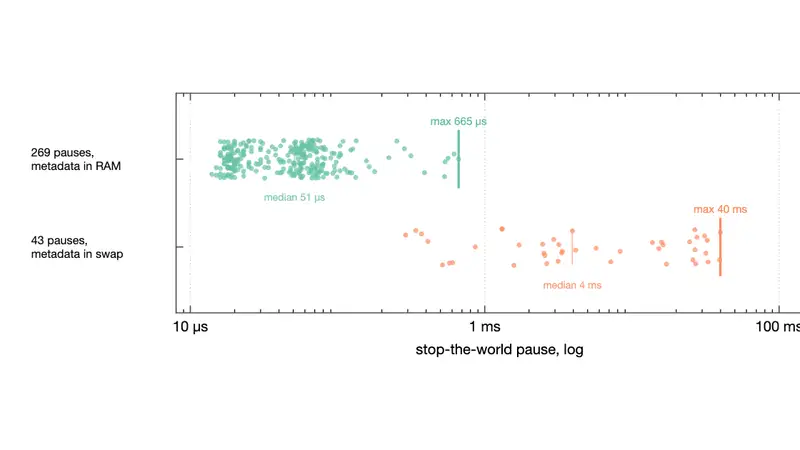
  3. Swapped Go GC metadata can turn a collection into a 40 ms pause
  4. LLM agents favor certain sources even when their items fit worse
Collected
460
Scored
320
Kept
50
Sources
49
Today's pulseOne beat per story, in page order. Taller beats scored higher.

Inference Benchmark

Qwen 125B runs locally at up to 94 tokens/s on tested consumer GPUs

Strata reports generation speeds of 53–94 tokens/s across quantizations on an RTX 5070 and an RX 9070 XT, with prompt processing also measured. Engineers weighing local inference can compare the speed and hardware trade-offs against server-based deployment.

  • WhatStrata runs the 125-billion-parameter Qwen3.8-Flash-Next model locally on consumer NVIDIA or AMD graphics cards.
  • HowOn two tested gaming PCs, measured answer speeds ranged from 44 to 94 tokens per second, depending on GPU and model size.
  • Why it mattersLocal inference keeps model use on the PC and makes a large model available without relying on a server.

Original · github.com 7 min read HN 745 pts · 333 comments

Notes & discussion

Agents Paper

LLM agents favor certain sources even when their items fit worse

Across 12 models and three domains, agents sometimes choose an item that meets one fewer requirement about two-thirds of the time when it comes from a preferred source; hiding or relabeling the source changes selection. The results expose a measurable bias in end-to-end search decisions that agent evaluations should account for.

Original · huggingface.co by Jonghyun Song et al.14 upvotes

Notes & discussion

Performance & OS Tool

Headstart overlaps Rust crate checks by emitting metadata early

Headstart lets dependent crates begin checking against early interface metadata while upstream crates continue checking function bodies; failed builds still report errors. The approach exposes a concrete way to trade some wasted work and memory for shorter build waits.

  • WhatHeadstart changes Rust compilation so dependent crates can start before their dependencies finish checking function bodies.
  • Howrustc writes early metadata after checking interfaces; cargo starts dependents from it, then waits for full metadata before code generation.
  • Why it mattersOverlapping crate checks can reduce build time and idle CPU capacity in large Rust workspaces, at the cost of extra memory and discarded work.

Original · github.com 5 min read HN 136 pts · 32 comments

Notes & discussion

Trending models Hugging Face

#ModelLikesMove
1 Cloudflare/clefimage text to text 1.3K+227 –
2 Aleph-Alpha/Kolibri-1text generation 447+169 ▲ 3
3 Cloudflare/clef-flashimage text to text 443+71 ▼ 1
4 Qwen/Qwen3.8-27Bimage text to text 17K+60 ▼ 1
5 Venastine-Research/Xing4.0-29B-A4B-GGUFtext generation 330+124 ▲ 6

Fast-rising repositories GitHub, created this week

#RepositoryStarsMove
1 rehan-remade/universal-modder 3.4K+669 ▲ 1
2 CopilotKit/OpenDots 3.3K+587 ▲ 1
3 feder-cr/dots 2.6K+28 ▲ 1

Agents

9 stories Topic page →

Release

CLM-8B uses contrastive state-action learning for agent tasks

CLM-8B adds state and action projection heads to a frozen Qwen3-8B encoder, trained with bidirectional InfoNCE; its zero-shot results are reported as on par with Jev on several agent tasks at up to 9× lower latency. The approach and latency claim are worth examining for teams building fast tool-use or computer-use systems.

  • WhatCLM-8B is a contrastive language model for ranking and agent tasks, built on a frozen Qwen3-8B encoder.
  • HowTwo projection heads encode states and actions, trained with a bidirectional InfoNCE loss; separately encoded actions can be reused for caching.
  • Why it mattersReusable action embeddings can speed candidate ranking, and the model can also serve as a verifier for agent tasks.

Original · huggingface.co 719 likes

Notes & discussion
state embeddi… action embedd… frozen Qwen3-8Bencoder state head action head
A frozen encoder feeds separate state and action projection heads. Sketched from the article's own text.

Benchmark

EditHero tests agents on long sequences of part-level 3D edits

EditHero evaluates long edit sequences against deterministic targets; compared with top-down methods, LLM/VLM agents follow instructions more closely and preserve untouched parts, but each edit takes minutes. The benchmark and planned release of its engine and sequences target reliability in iterative agent workflows.

Original · huggingface.co by Ruihan Yu et al.6 upvotes Code · 1 stars

Notes & discussion

Deep dive

A production RAG pipeline gives coding agents citable evidence from repositories

JetBrains describes building and shipping a code-search RAG pipeline intended to give LLM agents precise, citable repository evidence, with field notes beginning on parsing, chunking and vectorization. The production lessons are relevant to teams grounding coding agents in large codebases.

Original · blog.jetbrains.com 18 min read HN 36 pts · 9 comments Lobsters 1 pts · 1 comment

Notes & discussion
2 more stories

Inference

4 stories Topic page →

Release

vLLM 0.31.0 adds GPU optimizations and persistent weight caching

The release adds SM100 attention and KV-cache optimizations, fused operations, and a preload CLI that keeps post-quantized weights resident across engine restarts. These changes target inference performance and faster recovery of serving capacity.

  • WhatvLLM 0.31.0 is a release with GPU optimizations, serving features, scheduling controls, and fixes.
  • HowA new preload CLI launches a daemon that keeps post-quantized weights in GPU memory across engine restarts.
  • Why it mattersPersistent weight caching can support faster restarts in serving systems, while the release also adds controls for request admission and prefill scheduling.

Original · github.com 27 min read

Notes & discussion
launches keeps weights reused on res… vllm preload CLI weight-cachedaemon GPU memory engine
The preload CLI starts a daemon that retains weights in GPU memory across engine restarts. Sketched from the article's own text.

Models & training

7 stories Topic page →

Architecture

10 stories Topic page →

Case study

Four agents cut migration IaC development from weeks to minutes across 300+ apps

An enterprise migration program used a four-agent pattern alongside AWS migration services; internal tracking reports IaC development falling from 3–4 weeks per application to minutes. The hybrid design offers a concrete, measured example of where custom agents fit into large migrations.

  • WhatA four-agent pattern runs alongside AWS Transform and AWS DMS to support cloud migrations with organization-specific requirements.
  • HowThe Intake Agent reads inputs, the IaC Agent generates code using approved modules, the Governance Agent reports and governs, and the SRE Agent supports post-cutover operations.
  • Why it mattersInternal project tracking reports IaC development time falling from 3–4 weeks per application to minutes across a program of 300+ applications.

Original · aws.amazon.com by Nikhil Jha16 min read

Notes & discussion
tool access tool access exposes Intake Agent IaC Agent AgentCoreGateway MCP tools
Migration agents connect to organization-maintained MCP tools through AgentCore Gateway. Sketched from the article's own text.
3 more stories

Performance & OS

4 stories Topic page →

Deep dive

A Go compiler optimization makes IPv4-mapped IPv6 conversion eight times faster

The article reports that the `netip.AddrFrom16(ip.As16())` pattern is eight times slower than a native method and investigates compiler changes to optimize it. The benchmarks and assembly analysis make this a useful performance-engineering case for Go developers.

  • WhatA Go compiler optimization proposal targets the conversion pattern netip.AddrFrom16(ip.As16()) used to map IPv4 addresses to IPv4-mapped IPv6.
  • HowThe pattern is reported as eight times slower than a native method; the post examines standard-library, helper, unsafe, and compiler approaches.
  • Why it mattersOptimizing this conversion could improve performance in systems that repeatedly map IP addresses.

Original · vincent.bernat.ch 27 min read Lobsters 15 pts

Notes & discussion

Cloud & infra

3 stories Topic page →

Guide

OpenSSH reverse forwarding and Nginx provide self-hosted HTTP tunnels

The guide combines SSH remote forwarding on an automatically allocated port with an Nginx wildcard host that proxies requests to the forwarded service. It offers a practical self-hosted alternative for exposing local previews without a dedicated tunnel client.

  • WhatOpenSSH reverse forwarding and nginx can expose a local HTTP service through a self-hosted HTTPS tunnel.
  • HowSSH forwards a server port to localhost; nginx proxies requests for that port, while signed, expiring URLs add access control.
  • Why it mattersEngineers can share local previews without a commercial tunnel service or a specialized SSH server.

Original · vincent.bernat.ch 5 min read HN 122 pts · 30 comments Lobsters 15 pts · 6 comments

Notes & discussion
proxies forwards tunnels to nginx remote port OpenSSH localhost:8080
nginx proxies HTTPS requests through an OpenSSH reverse tunnel to a local service. Sketched from the article's own text.

Databases

2 stories Topic page →

Deep dive

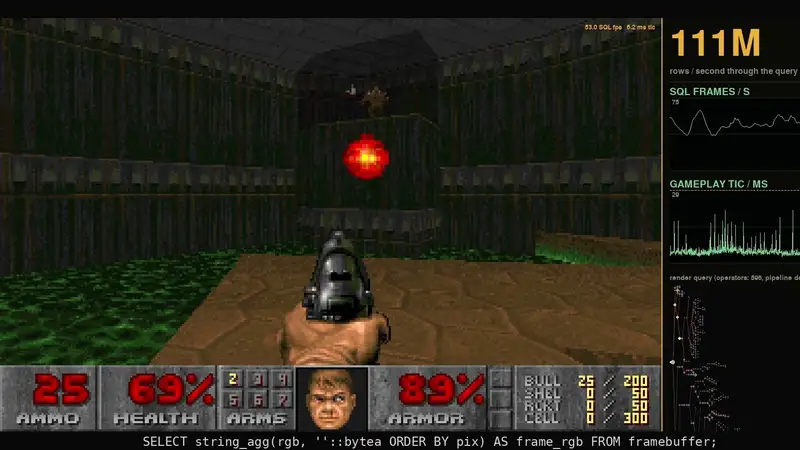
Doom’s game logic and renderer run in SQL at up to 60 Hz

The port runs Doom’s game loop at 35 FPS and renders 320×200 frames in SQL, with Python handling input, timing and display; multiplayer works too. It’s an unusual look at pushing a database beyond conventional query workloads.

  • WhatSQLDoom runs the original Doom game logic and renderer inside a database, with Python handling input, timing, and display.
  • HowSQL game logic runs at 35 FPS and updates game state tables; the renderer reads that state and can produce frames independently, up to 60 Hz.
  • Why it mattersIt demonstrates how database execution can host both application logic and rendering while separating the fixed game loop from frame requests.

Original · cedardb.com 25 min read HN 43 pts · 5 comments

Notes & discussion
game tic updates state bitmap Python SQL game logic game statetables SQL renderer
Python drives SQL game logic while the SQL renderer reads shared game state. Sketched from the article's own text.

Security

4 stories Topic page →

Deep dive

C2PA metadata can make a photoshopped image appear to predate an event

A photoshopped image uses C2PA metadata to appear to show lottery numbers before the draw, despite its verifiable signature and timestamp. The demonstration highlights why signed provenance alone may not establish when an image was actually created.

  • WhatC2PA metadata can include signatures and a timestamp from a remote Time Stamp Authority (TSA).
  • HowC2PA permits byte-range exclusions; excluding the entire file lets a signer alter it without invalidating the signatures or TSA timestamp.
  • Why it mattersEngineers validating content provenance must account for what signatures exclude, not treat a valid timestamp as proof that file contents stayed unchanged.

Original · da.vidbuchanan.co.uk 4 min read HN 58 pts · 7 comments

Notes & discussion
requests time… consults returns signa… C2PA manifest RFC 3161protocol Time StampAuthority C2PA metadata
A C2PA manifest gets a timestamp signature from a TSA through RFC 3161. Sketched from the article's own text.

Languages & tools

2 stories Topic page →

Deep dive

C++ bitwise operations can turn enum complements into unexpected values

The article examines how integral promotions and undefined behavior affect bitwise operations on C++ enums, prompted by a proposal for opt-in bitmask operations. Engineers working with low-level C++ can use this context to avoid subtle type and value bugs.

  • WhatThe excerpt examines C++ bitwise operations while discussing a proposal for built-in bitmask operations on enums.
  • HowIntegral types smaller than int are promoted for bitwise operations; converting a nonzero result to bool yields true and discards its bit pattern.
  • Why it mattersUnderstanding these conversions helps engineers avoid surprising boolean results and unintended narrowing in low-level code.

Original · dryperspective.github.io 16 min read Lobsters 34 pts · 4 comments

Notes & discussion

Web

1 story Topic page →

Essay

Web developers still have reasons to build beyond browser APIs

The essay weighs “use the platform” against the history of browser gaps, when libraries such as jQuery supplied features browsers had yet to implement. It offers useful context for choosing native APIs versus dependencies, though its focus is web development.

  • WhatThe piece examines why web developers often build with libraries instead of using browser platform APIs.
  • HowHistorical browser gaps, familiarity, documentation, and libraries’ more familiar interfaces all help explain that choice.
  • Why it mattersFor engineers, browser APIs can offer better performance and usability, while libraries can make unfamiliar platform features easier to adopt.

Original · nolanlawson.com 8 min read HN 295 pts · 308 comments Lobsters 68 pts · 33 comments

Notes & discussion

Sources today: Airbnb Engineering, AWS Architecture, AWS Machine Learning, Marc Brooker, ByteByteGo, Chips and Cheese, Cloudflare Blog, Google DeepMind, Discord Engineering, Dropbox Tech, DuckDB, Figma Engineering, Google Cloud, Go Blog, Google Research, Hamel Husain, Hugging Face, Import AI, InfoQ, Jane Street Tech, Latent Space, Lobsters (AI, distributed, performance), Armin Ronacher, LWN.net, Martin Fowler, Microsoft Research, NVIDIA Technical Blog, The Old New Thing, OpenAI, PlanetScale, Postgres Weekly, The Pragmatic Engineer, PyTorch, Sebastian Raschka, Rust Blog, Shopify Engineering, Simon Willison, Stripe Engineering, Trail of Bits, GitHub (new repositories), Hugging Face trending models, Hugging Face Daily Papers, Hacker News, Hacker News (AI and systems search), Lobsters, Ollama releases, OpenAI Agents SDK releases, Transformers releases, vLLM releases. Headlines, summaries and diagrams are written by gpt-6-luna from each source's own text; links and images come from the sources themselves. Follow the link before relying on a claim.

RSS · JSON · Markdown · Pulse · Search · Previous days

Your note

Private to you. Stored in this browser, and synced to your account when you are signed in.