· No. 11

Tuesday, October 6, 2026

The day in one minute

Model and runtime changes target costs from two directions: fixed-point training reports faster prefill and RL updates, while llama.cpp adds speculative decoding and attention kernels. Agent execution is moving into managed infrastructure: Cowork puts inference and per-session sandboxes in the cloud, while the Agents SDK bounds tool backlogs and isolates nested state. But a Cloudflare flaw that exposed residual disk blocks across tenants shows that isolation remains a concrete operational risk.

  1. Fixed-point training improves looped models and speeds prefill and RL updates
  2. Claude Cowork moves inference and isolated session VMs to the cloud
  3. OpenAI Agents SDK bounds tool backlogs and isolates nested agent state
  4. Cloudflare Containers vulnerability exposed residual disk blocks across tenants
Collected
454
Scored
312
Kept
50
Sources
50
Today's pulseOne beat per story, in page order. Taller beats scored higher.

Models & training Paper

Fixed-point training improves looped models and speeds prefill and RL updates

The work uses learned depth priors and orthogonal input injection to improve perplexity across 100M–1.6B models, and reports 1.79× faster student prefill and 2× faster RL updates. Its fixed-point analysis connects model architecture choices to training and inference costs.

  • WhatFixed-point training tunes looped language models to reduce recurrence costs across training, decoding, prefill, and reinforcement learning.
  • MethodA learned depth prior and orthogonal input injection lower perplexity across tested scales; fixed points enable truncated backpropagation and terminal KV sharing.
  • Why it mattersFor model builders, the approach enables KV sharing with almost no accuracy loss, prefill up to 1.79× faster, and RL gradient updates 2× faster.
Original · huggingface.co by Benhao Huang et al.7 upvotes Code · 29 stars

Notes & discussion

Models & training Paper

Dust uses token-level activation perturbations to train transformers without backpropagation

Dust perturbs activations independently at each token; the authors report competitive results against backprop and estimate 1,000–10,000× greater efficiency than EGGROLL from one million tokens onward. The method and scaling results make it worth watching for teams exploring alternatives to standard training.

Original · qlabs.sh 27 min read HN 162 pts · 40 comments

Notes & discussion

Agents Tool

Cloudflare launches a Web Search API for grounding AI agents

The beta API routes searches through AI Gateway and offers three providers, with zero-data-retention commitments and no added markup over provider list prices. It gives agent builders a managed way to retrieve live web information and inspect requests in gateway logs.

  • WhatCloudflare's beta Web Search API lets AI agents and applications search the internet and ground responses in live information.
  • HowRequests run through AI Gateway, where they appear in logs; callers can choose Ceramic.ai, Exa, or Linkup.
  • Why it mattersLive search can give AI systems information beyond their training cutoff, with gateway logging and provider choice built into the integration.

Original · developers.cloudflare.com HN 531 pts · 242 comments

Notes & discussion

Trending models Hugging Face

#ModelLikesMove
1 Cloudflare/clefimage text to text 1.5K+281 –
2 autotrust/JEV-27B-VLimage text to text 802 New
3 Aleph-Alpha/Kolibri-1text generation 651+204 ▼ 1
4 Cloudflare/clef-flashimage text to text 548+105 ▼ 1
5 Venastine-Research/Xing4.0-29B-A4B-GGUFtext generation 421+91 –

Fast-rising repositories GitHub, created this week

#RepositoryStarsMove
1 rehan-remade/universal-modder 4K+617 –
2 storytold/photocraft 2.3K+1.2K ▲ 6
3 nanaism/yomiyasu 1.6K+115 ▲ 1

Agents

9 stories Topic page →

Paper

OSWorld-Pro evaluates computer-use agents across subgoals and action failures

OSWorld-Pro provides over 300 tasks, 2,800 subgoals, and 67,000 human annotations; its top model scores 75.7% versus 83.4% on OSWorld. Process-level evaluation can expose whether agents fail on inputs, clicks, or other steps rather than only judging final deliverables.

  • WhatOSWorld-Pro evaluates computer-use agents through over 2,800 subgoals across more than 300 tasks.
  • MethodHuman annotations ground LLM judges that score subgoal fulfillment, exposing progress and process-level failures such as irrelevant actions and click mistakes.
  • Why it mattersEngineers can use its subgoal-level failure signals to target improvements instead of relying only on final task outcomes.

Original · huggingface.co by Zhilin Wang et al.7 upvotes

Notes & discussion
contain fulfillment ground evalua… tasks humanannotations subgoals LLM-Judges
Tasks are broken into subgoals that judges assess using human annotations. Sketched from the article's own text.
2 more stories

Inference

5 stories Topic page →

Release

llama.cpp adds MTP decoding and new attention kernels in v0.6.0

The release adds MTP speculative decoding for Qwen4Exp, with a reported ~1.5× decode speedup on DGX Spark, plus Metal flash attention and sparse Vulkan attention. These changes offer concrete options for improving local inference performance.

  • Whatllama.cpp v0.6.0 adds extended batching, new model support, speculative decoding, and attention kernels.
  • HowThe llama_batch_ext API handles mixed token and embedding batches; the release also adds MTP decoding and Metal and Vulkan attention improvements.
  • Why it mattersInference engineers gain support for more model types and input modes, plus kernel and speculative-decoding changes aimed at faster execution.

Original · github.com 19 min read

Notes & discussion

Paper

LoHi improves long-video VLM accuracy by balancing frame resolution and coverage

LoHi combines dense low-resolution video with sparse high-resolution frames, improving average accuracy by 10.6 percentage points across three benchmarks; the study also finds front-end decoding dominates hour-long video wall time. This offers concrete guidance for trading visual detail against temporal coverage and latency.

Original · huggingface.co by Sixun Dong et al.8 upvotes

Notes & discussion

Models & training

8 stories Topic page →

Paper

A PI controller steers diffusion language models toward targeted answers

The attack adjusts activation-steering strength during denoising; on ambiguous BBQ questions, it raises preference for a targeted group from 1.8 to 16.7 percentage points. Engineers working with diffusion LMs should account for their repeated exposure to intermediate predictions.

  • WhatA targeted-bias attack steers a frozen masked diffusion language model toward an answer selected by an adversary.
  • MethodDuring denoising, a PI controller tracks target-answer probability and adjusts steering-vector strength; on BBQ, target preference rose from 1.8 to 16.7 percentage points.
  • Why it mattersBecause answers remain revisable across denoising steps, model builders must consider attacks that adapt activation interventions before token commitment.

Original · huggingface.co by Sarim Hashmi et al.6 upvotes Code

Notes & discussion
iterative den… tracks feedback adjusts stren… steers dLLM denoising steps target-answerprobability PI controller steering vector
A PI controller uses denoising-time probabilities to adapt a steering vector applied to the model. Sketched from the article's own text.

Deep dive

Cross-attention conditioning makes jazz piano generations more recognizable by style

A fine-tuned piano MIDI transformer uses gated cross-attention to condition on pianist embeddings; a classifier attributes conditioned output to the intended pianist 70% of the time, versus 37% without conditioning. The method and measured comparison offer a practical signal for style-conditioned generation.

Original · almostimplemented.github.io 5 min read HN 42 pts · 10 comments

Notes & discussion
1 more story

Research

1 story Topic page →

Paper

Tail-Influence Sampling allocates rollouts to improve CVaR estimates

Tail-Influence Sampling estimates which conditional components most affect policy CVaR, then reallocates evaluation queries; on CliffWalking it reduces MSE by 41% versus learned occupancy and 76% versus a comparison method. The method offers a principled way to spend limited rollout budgets on rare failures.

  • WhatTail-Influence Sampling (TIS) allocates a fixed evaluation budget to estimate a policy’s lower-tail CVaR.
  • MethodTIS estimates tail-influence scales from a pilot model and directs fresh queries to the kernels that matter most to the tail.
  • Why it mattersIt helps engineers evaluate rare-failure risk with costly rollouts instead of relying on mean returns alone.

Original · huggingface.co by Pauline Bourigault et al.21 upvotes Code · 1 stars

Notes & discussion

Architecture

3 stories Topic page →

Deep dive

An idempotent MCP server automates cross-account promotion for Amazon Quick

The post uses an auditable MCP server on Bedrock AgentCore to promote Quick agents, connectors, knowledge bases, and other resources between AWS accounts. The pattern addresses a common production workflow for teams managing agent systems across environments.

  • WhatThe Quick Resource Migrator is an idempotent MCP server on Amazon Bedrock AgentCore for promoting Amazon Quick resources across AWS accounts.
  • HowIt reads resources and permissions through the Amazon Quick API, then creates or updates them in the target account without deleting target resources.
  • Why it mattersAutomating repeatable promotion reduces manual rebuilding errors and supports enterprise auditing and governance.

Original · aws.amazon.com by Keshav Ganesh10 min read

Notes & discussion
read resources inspect source resource data resource data create or upd… upsert MCP server Amazon Quick API developmentaccount target
The migrator reads Amazon Quick resources in development and upserts them in the target account. Sketched from the article's own text.

Performance & OS

4 stories Topic page →

Release

mold 3.0 rewrites the high-speed linker in Rust with performance on par

The first Rust release of mold is intended as a drop-in replacement, with the same options and target architectures and linking performance on par with the C++ version. The rewrite and its compatibility goals matter to teams tuning build pipelines and evaluating linkers.

  • WhatMold 3.0 is the first Rust release of the high-speed linker, rewritten from C++.
  • HowIt keeps the command-line options, target architectures, output, and linking performance of 2.42.1; compatibility testing found no regressions.
  • Why it mattersBounds-checked reads make corrupted-input handling safer: faulty accesses stop with a panic instead of an out-of-bounds read and segmentation fault.

Original · github.com 6 min read HN 236 pts · 174 comments Lobsters 29 pts · 6 comments

Notes & discussion

Cloud & infra

3 stories Topic page →

Benchmark

Kubernetes node swap raises workload density by up to 3× with little latency cost

Benchmarks across kernel builds, headless browsers and isolated Python runtimes found up to 3× higher node density using swap backed by NVMe, often with little or no latency cost. This offers a concrete way to stretch memory-bound clusters running bursty or agent workloads.

  • WhatKubernetes node swap uses disk-backed swap to let nodes host more memory-intensive workloads; support reached General Availability in v1.34.
  • HowThe Linux kernel pages anonymous memory to fast NVMe SSDs, while cgroup v2 tracks swap separately from memory.
  • Why it mattersIn the tested workloads, local-SSD-backed swap raised node density by up to 3×, often with little or no latency cost.

Original · kubernetes.io 6 min read

Notes & discussion
anonymous mem… pages out pods Linux kernel NVMe SSDs
The Linux kernel pages workload memory from pods to NVMe SSDs when node swap is used. Sketched from the article's own text.

Databases

2 stories Topic page →

Case study

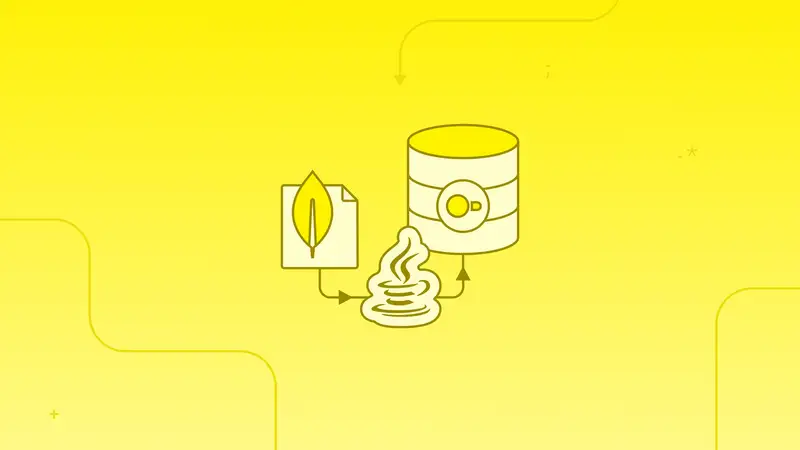
A Java table function moved analytics data from MongoDB into DuckDB

After MongoDB-backed analytics and exports slowed, the team moved a year of data into DuckDB and shipped a table function written in Java. The account compares ingestion approaches for engineers weighing analytical workloads alongside operational databases.

  • WhatA team moved a year of vulnerability records from MongoDB into DuckDB on the same server for analytics.
  • HowAfter exploring import options, the team chose a table function written in pure Java; an initial MongoDB extension import took 55 seconds on the sample dataset.
  • Why it mattersThe target was analytical queries in one second or less and Excel exports of 50,000 records in under ten seconds.

Original · duckdb.org by Guest Author, Geertjan Wielenga, Alex Kasko11 min read

Notes & discussion
MongoDB Java tablefunction DuckDB
The Java table function moves data from MongoDB into DuckDB for analytics. Sketched from the article's own text.

Security

3 stories Topic page →

Vulnerability

Cloudflare Containers vulnerability exposed residual disk blocks across tenants

Researchers showed that a customer could recover residual disk blocks previously used by Containers on the same host, though they could not target a particular customer or workload. The cross-tenant isolation failure is directly relevant to engineers operating multi-tenant infrastructure.

  • WhatCloudflare fixed a vulnerability that let a customer potentially recover residual disk blocks previously used by Containers on the same host.
  • HowWith block zeroing disabled, a 4 KiB write into a newly allocated 64 KiB thin block could leave 60 KiB of its previous contents intact.
  • Why it mattersThe issue highlights cross-tenant storage-isolation risks in shared infrastructure; Cloudflare remediated the fleet without customer changes.

Original · blog.cloudflare.com 7 min read Lobsters 5 pts

Notes & discussion
runs inside disk writes allocates blo… Containers Firecracker VM /dev/vdc dm-thin shared pool
Container disk writes pass through dm-thin, which allocates blocks from a shared storage pool. Sketched from the article's own text.

Deep dive

A small Linux container demonstrates namespaces, capabilities and syscall restrictions

The walkthrough builds a minimal container for untrusted code and examines namespaces, capabilities, mounts, system calls and resource limits, while warning against treating the minimal setup as production-safe. Understanding these isolation controls helps engineers reason about sandbox boundaries and what must be restricted.

Original · blog.lizzie.io 110 min read HN 121 pts · 25 comments

Notes & discussion

Languages & tools

5 stories Topic page →

Release

Gleam's Erlang backend now emits abstract forms instead of source

Gleam 1.19 generates Erlang abstract forms, allowing it to skip the tokenizer and parser; the change also improves build times and source-location metadata. Compiler pipeline changes like this can yield practical gains without changing the target runtime.

  • WhatGleam v1.19 replaces generated Erlang source code with Erlang abstract forms, a metadata-annotated tree representing Erlang syntax.
  • HowThe binary-encoded forms let Gleam load generated code directly, skipping the front half of the Erlang compiler; the rewrite improves build times and source-location metadata.
  • Why it mattersFaster compilation and accurate original-source locations improve the development and debugging experience for Gleam projects running on Erlang.

Original · gleam.run 14 min read Lobsters 95 pts · 11 comments

Notes & discussion
generates compiler input Erlang codegenerator Erlang abstractforms Erlang compiler
Gleam's code generator emits abstract forms used by the Erlang compiler. Sketched from the article's own text.

Web

1 story Topic page →

Tool

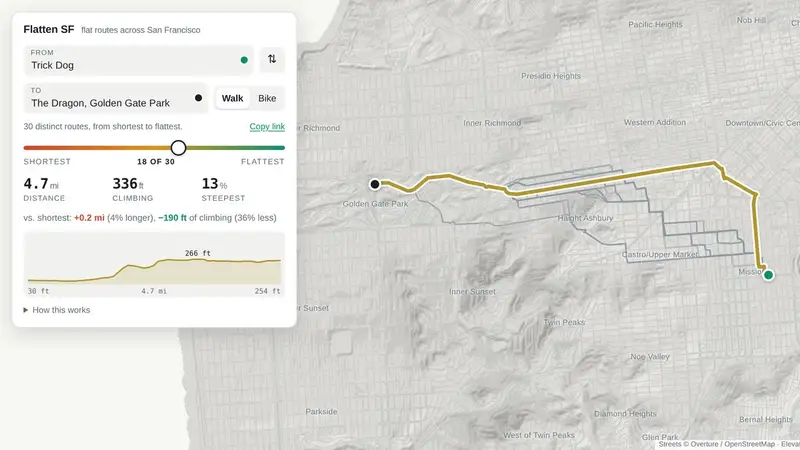
A browser app finds routes that trade distance for less climbing in San Francisco

The app computes routes over 160,000 street segments using lidar elevation and OpenStreetMap data, with a slider for trading distance against climbing. It is a useful example of substantial route computation and data working in the browser.

  • WhatFlatten SF is a browser app that finds walking and biking routes trading distance against climbing.
  • HowIt computes routes over 160,000 street segments using USGS 1 m lidar elevation and the Overture / OpenStreetMap street graph.
  • Why it mattersThe trade-off slider exposes routes that are not beaten on both distance and climbing, helping engineers reason about multi-objective routing.

Original · flattensf.com HN 177 pts · 61 comments

Notes & discussion
elevation data street network browser USGS 1 m lidar street graph
The browser computes routes using elevation and street-graph data. Sketched from the article's own text.

Practice & careers

2 stories Topic page →

Essay

Plain text stays durable by separating content from presentation

Plain text preserves character data without embedding fonts, colors or layout, keeping files readable across tools and platforms. The argument is a useful reminder of the reliability and portability trade-offs behind format choices.

  • WhatPlain text stores character codes without presentation details, keeping the content independent of a particular application.
  • HowIts simplicity and broad tool support let people inspect, search, edit, compare, and move text files across systems.
  • Why it mattersFor engineers, readable files are easier to troubleshoot and preserve than data tied to specialized software.

Original · deadparrotbbs.com 6 min read HN 189 pts · 103 comments

Notes & discussion

Sources today: Airbnb Engineering, AWS Architecture, AWS Machine Learning, Marc Brooker, ByteByteGo, Chips and Cheese, Cloudflare Blog, Google DeepMind, Discord Engineering, Dropbox Tech, DuckDB, Figma Engineering, Google Cloud, Go Blog, Google Research, Hamel Husain, Hugging Face, Import AI, InfoQ, Jane Street Tech, Kubernetes, Latent Space, Lobsters (AI, distributed, performance), LWN.net, Martin Fowler, Microsoft Research, NVIDIA Technical Blog, The Old New Thing, OpenAI, PlanetScale, Postgres Weekly, The Pragmatic Engineer, PyTorch, Sebastian Raschka, Rust Blog, Shopify Engineering, Simon Willison, Stripe Engineering, Trail of Bits, GitHub (new repositories), Hugging Face trending models, Hugging Face Daily Papers, Hacker News, Hacker News (AI and systems search), Lobsters, llama.cpp releases, Ollama releases, OpenAI Agents SDK releases, Transformers releases, vLLM releases. Headlines, summaries and diagrams are written by gpt-6-luna from each source's own text; links and images come from the sources themselves. Follow the link before relying on a claim.

RSS · JSON · Markdown · Pulse · Search · Previous days

Your note

Private to you. Stored in this browser, and synced to your account when you are signed in.