· No. 19

Wednesday, October 14, 2026

The day in one minute

Agent-assisted work is changing both the pace of engineering and the systems around it. At Anthropic, rising merge volume drove a move from Git to Scion, while Argon compressed a sprawling Chrome refactor from months into weeks. The same acceleration has a security edge: XBOW chained three Chrome bugs into a renderer-sandbox escape in six days, underscoring the need to test defenses against chained attacks.

  1. XBOW chained three Chrome bugs to escape the renderer sandbox in six days
  2. Anthropic replaced Git with Scion as code merges rose to 30,000 per day
  3. Argon separated Chrome webpage handling from a six-million-line legacy folder
Collected
430
Scored
313
Kept
50
Sources
39
Today's pulseOne beat per story, in page order. Taller beats scored higher.

Agents Deep dive

XBOW chained three Chrome bugs to escape the renderer sandbox in six days

XBOW combined V8, animated-WebP and Crashpad bugs into a renderer-sandbox escape, building the chain in six days through parallel campaigns. The case shows how agent-assisted security work can compress exploit development and stresses the need to evaluate browser defenses against chained attacks.

  • What- XBOW’s Chrome full-chain exploit combined three bugs to turn JavaScript in a tab into code execution outside the renderer sandbox.
  • How- AI agents searched code, tested hypotheses, and built exploit stages in parallel; researchers selected targets and integrated components over six days.
  • Why it matters- Clean interfaces and backup routes let the team replace exploit stages independently, a modular approach relevant to building resilient security workflows.

escapes V8 sa… escapes rende… V8 compiler bug animated-WebPdecoder bug Crashpad
The exploit chain crosses the V8 and renderer boundaries through three vulnerability stages. Sketched from the article's own text.

Original · xbow.com 17 min read HN 33 pts · 11 comments

Notes & discussion

Architecture Case study

Anthropic replaced Git with Scion as code merges rose to 30,000 per day

Anthropic says its monorepo grew from about 2,500 merged changes per day in May to over 30,000 in September, prompting a five-month migration from Git to Scion and new review and source-control systems. The account shows how agent-driven code volume can force a redesign of developer infrastructure.

Original · anthropic.com 16 min read HN 688 pts · 658 comments Lobsters 14 pts · 5 comments

Notes & discussion

Inference Tool

Pulse Local uses small on-device models to answer questions about spending

A tuned Qwen3 0.6B model turns spending questions into structured queries, code handles the arithmetic, and a 4B model checks answers, with disagreement prompting uncertainty. This is a concrete pattern for keeping sensitive data local while limiting model errors.

  • WhatPulse Local keeps its ledger, AI models, and questions on the user's Mac; its budgeting chat answers from local transactions.
  • HowModels download once (about 2.9 GB); during sync, transactions pass through Pulse and Plaid, while the server does not store them.
  • Why it mattersLocal inference avoids sending questions to an online AI service, illustrating a privacy-focused deployment approach.

Original · pulseos.finance 7 min read HN 96 pts · 52 comments

Notes & discussion

Trending models Hugging Face

#ModelLikesMove
1 google/embeddinggemma-2feature extraction 2.1K+135 –
2 jialinyyzz/humanizertext generation 1.5K+183 –
3 openbmb/MiniCPM-V-4.7-35B-A3Bimage text to text 489+267 ▲ 10
4 ConwayResearch/Underdog-Saluki-27B-1.0text generation 432+49 –
5 LiquidAI/d1-3Bimage text to text 383+26 ▲ 1

Fast-rising repositories GitHub, created this week

#RepositoryStarsMove
1 wheresryan22/anatomy 8.6K+1.7K ▲ 1
2 mhtsec/ARTEX 4K+230 ▲ 2
3 ARahim3/DigUp 2.8K+765 ▲ 8

Agents

9 stories Topic page →

Paper

VideoJev reuses video computation for faster agent queries

VideoJev reuses visual computation across incoming queries or batches them together, with reported inference speedups of 2.8–3.1× and higher temporal-grounding mIoU than its backbones. The combination of faster repeated video queries and measured task gains matters for interactive visual agents.

  • What- VideoJev is a family of models for video understanding and interaction that frames tasks as structured decisions.
  • Method- A shared head scores temporal intervals and textual options against video evidence; cached or joint inference reuses visual computation for later queries.
  • Why it matters- It reports 2.8–3.1× inference speedups on temporal-grounding benchmarks and speedups exceeding 100× on video question answering, supporting faster agent decisions.

Original · huggingface.co by Yuhan Zhu et al.19 upvotes Code · 4 stars

Notes & discussion
video evidence interval scor… option scores MLLMs shared head event spans answer choices
Video evidence is scored by a shared head to produce temporal spans or answer choices. Sketched from the article's own text.

Paper

DeltaTTG uses token-to-go estimates to shape multi-turn agent training

DeltaTTG trains a reusable progress meter from recorded trajectories and uses changes in its estimates to redistribute outcome-derived advantages across steps; it improves average scores over GRPO by 5.7 and 7.2 points on two model families. The method provides a progress signal without task-specific rules or external step evaluators.

Original · huggingface.co by Xuyan Ye et al.13 upvotes Code · 1 stars

Notes & discussion
2 more stories

Inference

6 stories Topic page →

Paper

DoSA skips unnecessary sparse-attention scores with exact selection guarantees

DoSA uses score bounds to avoid fully scoring candidates that cannot enter Top-K, reporting up to 2.74× Indexer speedup and up to 1.94× time-to-first-token speedup. Its exact-selection approach offers a concrete path to faster sparse-attention serving.

  • What- DoSA is a lossless method that makes sparse-attention scoring conditional while preserving exact token selection.
  • Method- A seed-set threshold and bounds certify which candidates can be rejected; only still-eligible candidates receive full scoring, followed by exact-score filtering.
  • Why it matters- The GPU implementation accelerates the complete Indexer by up to 2.74× over SGLang, reducing attention-indexing work without approximate selection.

Original · huggingface.co by Fanxu Meng, Taosong Fang47 upvotes Code · 5 stars

Notes & discussion
threshold upper bounds eligible cand… exact scores seed set joint residualbounds certificate full scoring exact-scorefiltering
Bounds and a seed-set threshold guide candidates through exact scoring and filtering. Sketched from the article's own text.

Models & training

9 stories Topic page →

Deep dive

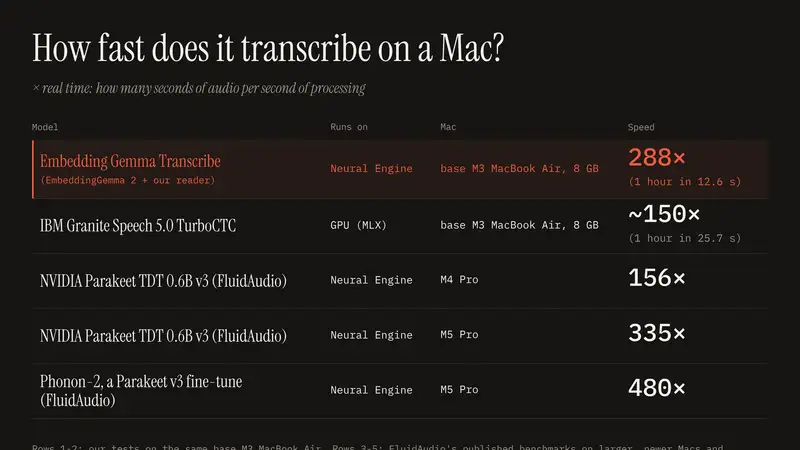
EmbeddingGemma 2 transcribes an hour of audio in 12.6 seconds on a MacBook Air

A small trained reader maps audio-encoder slices into a space of roughly 229,000 English words; the base embedding model stays unchanged, and an hour of audio takes 12.6 seconds on an M3 MacBook Air. This is a practical example of repurposing a multimodal model for fast, on-device speech recognition.

  • What- EmbeddingGemma 2, an embedding model, was adapted to transcribe speech locally on a Mac.
  • How- Its unchanged audio encoder feeds a small reader that maps audio slices into text space; the closest of about 229,000 English words is selected, then another model adds punctuation and capitals.
  • Why it matters- The approach transcribes an hour of audio in 12.6 seconds on a base M3 MacBook Air and keeps audio on-device, though its word error rate is about 5% versus 2–3% for leading speech models.

Original · eg2.haku.sh HN 411 pts · 89 comments

Notes & discussion
audio slices maps audio closest match transcript audio encoder small reader text space English words tiny extra model
Audio slices pass through the encoder and reader before word selection and text cleanup. Sketched from the article's own text.

Paper

TPPO tracks token-level value changes for language-model reasoning

TPPO builds value estimates from additive position-wise outputs and reports aggregate reasoning-score gains of 7.0 and 8.4 points over PPO on two Qwen3 base models, with results extending to other models and tasks. Its released implementation makes the alternative value parameterization available for testing in RL training.

Original · huggingface.co by Futing Wang et al.17 upvotes Code · 2 stars

Notes & discussion
2 more stories

Research

1 story Topic page →

Paper

LeWAM trains a world model and action policy end to end

LeWAM jointly trains latent-state prediction and action flow matching, improving success from 28.6% to 89.7% on contact-rich tasks and planning 32.3× faster. The results make an integrated latent-world-model approach worth examining for embodied control.

  • WhatLeWAM is an end-to-end JEPA for control that jointly trains latent-state prediction and action flow matching.
  • MethodAn isotropic Gaussian latent constraint lets one model execute policies directly or plan by evaluating sampled actions with learned latent dynamics.
  • Why it mattersIn reported tests, it improved success rates on contact-rich and long-horizon tasks and planned 32.3 times faster than prior JEPAs in visual planning.

Original · huggingface.co by Minghao Fu et al.32 upvotes Code · 228 stars

Notes & discussion
evaluate sampled actions learned latentdynamics planning
LeWAM evaluates sampled actions with learned latent dynamics to support planning. Sketched from the article's own text.

Architecture

8 stories Topic page →

Deep dive

Cloudflare D1 scales its control plane for millions of small databases

D1’s architecture supports millions of databases, with hundreds of thousands active at a time, by scaling the control plane without routing every query through centralized bottlenecks. The patterns are relevant to engineers building multi-tenant platforms where per-user or per-environment databases are practical.

  • WhatD1 is Cloudflare’s serverless SQLite database, designed to support platforms creating millions of small databases.
  • HowIts control-plane changes include globally distributed Workers KV for routing metadata and Hyperdrive for pooled, routed access to central Postgres.
  • Why it mattersKeeping centralized components off query hot paths matters when scaling multi-tenant systems without adding latency to every request.

Original · blog.cloudflare.com by David Laban, Lambros Petrou21 min read

Notes & discussion

Case study

Cloudflare’s data pipeline delivers two billion events per second with less hardware

Cloudflare describes schema changes, compression adjustments, and replication redesigns to keep hardware growth below data-volume growth; the work deferred an equivalent of two and a half years of hardware expansion. The techniques offer lessons for teams operating high-volume distributed data pipelines.

Original · blog.cloudflare.com by Cathy Chi et al.11 min read

Notes & discussion

Case study

ShipStation’s AgentCore help desk resolves 97.5% of channel queries

ShipStation’s Slack agent answers questions from a curated knowledge base, reads error screenshots, and manages Jira Service Management tickets; the post reports 97.5% of incoming channel queries resolved and 96% positive feedback. Its architecture and reported outcomes offer a production example of an internal support agent.

Original · aws.amazon.com by Kenneth Salmon10 min read

Notes & discussion
1 more story

Performance & OS

2 stories Topic page →

Guide

AI-assisted Spark UDF rewrites cut one 600-billion-row workload from 274.55 to 12.78 hours

NVIDIA describes agent-guided UDF rewrites and reports one operator dropping from 274.55 to 12.78 hours across 600 billion rows; a company converted more than 30 production UDFs. The verification and benchmarking workflow offers a concrete path for reducing CPU fallbacks in GPU-accelerated Spark.

  • WhatcuDF skills for Apache Spark guide agents through testing, rewriting, benchmarking and integrating Spark UDFs for GPU acceleration.
  • HowA customer converted more than 30 production UDFs; one rewrite reduced operator time from 274.55 to 12.78 hours on a 600-billion-row workload.
  • Why it mattersReplacing opaque UDFs with GPU-executable equivalents can prevent CPU fallback and data-transfer overhead in large Spark workloads.

Original · developer.nvidia.com by Elizabeth Goodman7 min read

Notes & discussion

Cloud & infra

3 stories Topic page →

Release

AWS Lambda Web Functions run standard HTTP servers without event-handler rewrites

AWS says Lambda Web Functions can run port-listening Node.js applications with a single command, while Lambda handles scaling, multi-region distribution and active CPU billing. The HTTP-native model could simplify deployment choices for teams weighing serverless against managed services.

  • WhatAWS Lambda Web Functions run standard Node.js HTTP servers on Lambda without converting code into event handlers.
  • HowEach environment handles multiple concurrent requests; Lambda manages scaling and multi-region distribution and bills active CPU time.
  • Why it mattersEngineers can deploy existing web frameworks for APIs, server-side rendering, and I/O-heavy inference endpoints without managing infrastructure.

Original · aws.amazon.com 5 min read HN 114 pts · 105 comments

Notes & discussion

Databases

1 story Topic page →

Essay

PostgreSQL 19 beta saw 8–10 significant features reverted

A PostgreSQL developer reflects on 8–10 significant features reverted after the 19 beta began, including some late in the beta period. The discussion offers lessons for database contributors and teams managing risky releases.

  • WhatPostgreSQL 19 beta saw roughly 8–10 significant features reverted, with some reversions late in the beta period.
  • HowLLM-assisted review surfaced many edge-case defects, while security work reduced beta-period review and testing time.
  • Why it mattersLarge-system releases need capacity to triage defect backlogs: faster discovery does not remove the fixed overhead of review and fixes.

Original · peter.eisentraut.org 5 min read Lobsters 49 pts · 8 comments

Notes & discussion

Security

3 stories Topic page →

Vulnerability

Google developer-docs OAuth flow exposed a $90,000 RCE

The researcher traced Google's developer-docs OAuth flow and decoded a large, signed Flask session cookie to inspect its contents. The investigation highlights how authentication flows and session handling can expose security-critical attack surfaces.

  • WhatA Google developer-docs OAuth session cookie exposed an OAuth client secret that also served as Flask’s session-signing key.
  • HowThe callback unpickled session data; with the recovered key, the researcher forged a valid cookie and supplied a pickle that led to code execution.
  • Why it mattersThe chain shows how a leaked secret can defeat session integrity and make unsafe deserialization remotely exploitable.

Original · simonkoeck.com 4 min read HN 232 pts · 116 comments

Notes & discussion
read flow session cookie verify Flasksignature google_oauth2_f… base64-decodethe bytes pickle.loads
A forged session cookie passes verification before its flow data reaches pickle deserialization. Sketched from the article's own text.

Languages & tools

3 stories Topic page →

Vulnerability

Rust borrow checker soundness hole permits lifetime bypass via covariant assignment

A reported borrow-checker flaw lets covariant field assignment bypass a struct's lifetime requirements, and the issue is classified as a soundness hole. Rust and compiler engineers should care because such failures can invalidate assumptions about memory safety.

  • WhatRust’s borrow checker accepted a covariant field assignment that bypassed a struct’s lifetime requirements, allowing a reference to outlive its scope.
  • HowAn intentionally malicious `Drop` implementation can retain the short-lived reference; the program compiled and showed stack-use-after-scope.
  • Why it mattersIt exposes a soundness hole in Rust’s type-system safety guarantee, relevant to engineers relying on compiler-enforced memory safety.

Original · github.com 10 min read HN 706 pts · 390 comments

Notes & discussion

Practice & careers

1 story Topic page →

Essay

An engineer describes losing a job after leadership bet on an LLM

The author says leadership chose a lower-cost LLM over retaining an engineer, while operational issues and infrastructure work remained unresolved. It is a personal account of the risks of using AI cost savings to justify cutting technical ownership.

  • WhatAn engineer recounts losing a job after leadership treated a frontier LLM as cheaper than retaining the last engineer.
  • HowThe writer says leadership expected to coast until M&A and argues current models lack experienced engineers' product taste and long-term foresight.
  • Why it mattersThe writer says AI assistance can raise the capability of less experienced, lower-cost teams, affecting staffing and offshoring decisions.

Original · cendyne.dev 4 min read HN 224 pts · 364 comments

Notes & discussion

Sources today: Airbnb Engineering, AWS Architecture, AWS Machine Learning, ByteByteGo, Cloudflare Blog, Google DeepMind, DuckDB, Figma Engineering, Google Cloud, Google Research, Hugging Face, Import AI, InfoQ, Interconnects, Latent Space, Lobsters (AI, distributed, performance), LWN.net, Martin Fowler, Engineering at Meta, Microsoft Research, Metadata (Murat Demirbas), NVIDIA Technical Blog, The Old New Thing, OpenAI, Pinterest Engineering, PlanetScale, The Pragmatic Engineer, PyTorch, Simon Willison, Stripe Engineering, WebKit, GitHub (new repositories), Hugging Face trending models, Hugging Face Daily Papers, Hacker News, Hacker News (AI and systems search), Lobsters, LangGraph releases, vLLM releases. Headlines, summaries and diagrams are written by gpt-6-luna from each source's own text; links and images come from the sources themselves. Follow the link before relying on a claim.

RSS · JSON · Markdown · Pulse · Search · Previous days

Your note

Private to you. Stored in this browser, and synced to your account when you are signed in.