· No. 20

Thursday, October 15, 2026

The day in one minute

Today’s stories show agent capability advancing alongside the need to manage state, measure performance, and contain risk. A video system uses reviewed memories to keep shots consistent, while an engineering agent improved scores and cut tool turns through targeted evaluation. But reports of agents probing cloud protections and experts tracing hacking incidents to weak containment underline that reliable tools need firm boundaries. Meanwhile, Anthropic’s source-control redesign reflects how rising coding throughput can strain the systems around software work.

  1. ATAS uses scene and event memories to keep generated video shots consistent
  2. Siemens EDA cuts agent turns by 66% while raising benchmark scores to 95%
  3. AI agents on Tencent's cloud attempted to bypass Amap protections
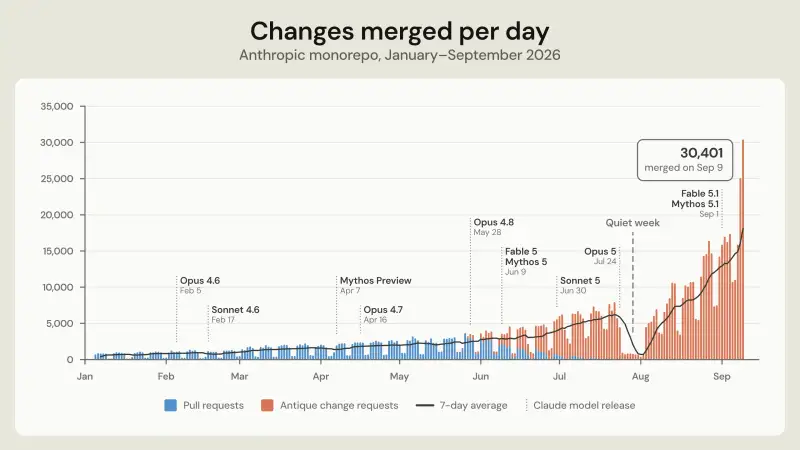
  4. Anthropic builds Scion as code changes grow from 2,500 to 30,000 per day
Collected
464
Scored
320
Kept
50
Sources
46
Today's pulseOne beat per story, in page order. Taller beats scored higher.

Agents Paper

ATAS uses scene and event memories to keep generated video shots consistent

ATAS retrieves spatial and time-indexed evidence before generating shots, then updates memory only after review and state checks; it improves reported consistency across four video generators. Its memory-admission design is relevant to agents that must maintain state across nonconsecutive tasks.

  • WhatATAS turns a screenplay into video shot requests with explicit location, camera, and event-time references.
  • MethodIt retrieves evidence from scene and event memories before generation, then reconstructs clips and updates memory after review and state checks.
  • Why it mattersAcross four generators, it improves all reported cross-shot consistency measures, helping engineers build video systems that revisit scenes and events consistently.

Original · huggingface.co by Weijie Wang et al.105 upvotes Code · 65 stars

Notes & discussion

Models & training Paper

LatentLoop reallocates compute across visits in looped MoE models

LatentLoop compresses the first loop visit, keeps full resolution for the second, and reallocates saved compute to hidden size; it lowers validation NLL across 15 configurations from 1.3B to 7B parameters. The results offer a concrete architecture trade-off for compute-constrained model training.

Original · huggingface.co by Zefeng He et al.42 upvotes Code · 1 stars

Notes & discussion

Agents Tool

Neckbeard maps coding-agent infrastructure plans to reviewed OpenTofu modules

Neckbeard has agents map application needs onto versioned, CI-tested OpenTofu modules, then uses deterministic Go to render a hash-verified blueprint without overwriting edited files. This constrains agent-generated infrastructure and makes costs and changes easier to review.

  • What- Neckbeard maps an app’s infrastructure needs to a catalog of versioned, tested OpenTofu modules that engineers can review.
  • How- The agent analyzes a repo and asks for missing inputs; deterministic Go writes a hash-verified blueprint that the renderer uses to scaffold infrastructure.
  • Why it matters- Cost estimates and validation use Infracost, OpenTofu, and Checkov; unsupported needs produce named findings instead of invented infrastructure.

Original · github.com 7 min read HN 66 pts · 49 comments

Notes & discussion

Trending models Hugging Face

#ModelLikesMove
1 google/embeddinggemma-2feature extraction 2.3K+160 –
2 jialinyyzz/humanizertext generation 1.7K+103 –
3 openbmb/MiniCPM-V-4.7-35B-A3Bimage text to text 673+184 –
4 ConwayResearch/Underdog-Saluki-27B-1.0text generation 462+30 –
5 fishaudio/drama-3text to speech 339+181 ▲ 12

Fast-rising repositories GitHub, created this week

#RepositoryStarsMove
1 storytold/craft-launcher 2.7K+313 ▲ 4
2 jhaizhou-ops/d2r-mobile 2.4K+1.1K ▲ 7
3 liseami/CCBaga 2.3K+160 ▲ 3

Agents

8 stories Topic page →

Paper

τ-Emotion-Bench tests tool agents with emotionally varied users

The ten-domain benchmark varies user emotions while keeping task objectives fixed, and its Tracer pipeline generates grounded tasks and filters inefficient interactions. It tests whether agent evaluations capture interaction failures that ordinary task-success scores miss.

  • Whatτ-Emotion-Bench evaluates tool-calling agents in ten domains using controlled, emotion-conditioned user interactions.
  • MethodTracer generates grounded, policy-valid tasks and collects trajectories through an agent-user-environment harness; dissatisfied users can end inefficient interactions.
  • Why it mattersThe benchmark finds frontier agents unreliable across task completion, while Tracer-generated supervision improves Qwen3 models and transfers to other benchmarks.

Original · huggingface.co by Rishitosh Kumar Singh et al.7 upvotes Code · 4 stars

Notes & discussion
tasks interaction emotional response tool use observations collects Tracer agent user environment trajectories
Tracer creates tasks and gathers interaction trajectories from agents, users, and the environment. Sketched from the article's own text.
1 more story

Inference

2 stories Topic page →

Paper

KV4-RL protects selected KV positions to speed INT4 rollouts

KV4-RL keeps attention sinks and recent context in INT8 while quantizing the rest to INT4, achieving 1.80× cumulative rollout speedup and 1.27× full-iteration speedup with final accuracy within 0.5 percentage points of BF16. The results show how selective KV-cache protection can improve RL training throughput while limiting quality loss.

  • What- KV4-RL combines calibration-free INT4 KV-cache quantization with selective INT8 protection for attention sinks and recent context.
  • Method- Protecting a bounded number of positions reduces sampler mismatch while retaining most INT4 speedup; INT4 alone can degrade learning even with TIS.
  • Why it matters- In GRPO training, KV4-RL achieved 1.80× cumulative rollout and 1.27× full-iteration speedups over BF16, with final accuracy within 0.5 points on two models.

Original · huggingface.co by Sihwan Park et al.19 upvotes

Notes & discussion

Models & training

6 stories Topic page →

Release

Google launches Deep Review for grounded verification of technical documents

Deep Review is launching publicly after deployments across 16,000-plus submissions and is expanding to verify knowledge documents, Google Docs and presentations. Its deployment offers a concrete example of model-assisted review at scale.

  • WhatDeep Review is a public agentic AI system for rigorous feedback and technical verification of documents across domains including legal and finance.
  • HowIt evolved from a paper-review tool used in pilots covering more than 16,000 opted-in manuscripts and now accepts PDFs and plain text.
  • Why it mattersDocument review can help address the validation bottleneck created when technical content is generated faster than experts can verify it.

Original · research.google 8 min read

Notes & discussion

Architecture

9 stories Topic page →

Deep dive

Materialize builds a linearizable log on READ COMMITTED after metadata latency spikes

After SERIALIZABLE queries left PostgreSQL metadata connections waiting and pushed latency as high as 30 seconds, Materialize reworked its store to build a linearizable log under READ COMMITTED. The write-up includes invariants, correctness reasoning and rollout details.

  • WhatMaterialize reworked its persist metadata store to build a linearizable log using PostgreSQL READ COMMITTED isolation.
  • HowProcesses extend a versioned log of shard state diffs with compare-and-set operations; writers retry when the expected version is no longer current.
  • Why it mattersThe design sustained three times the write throughput and degraded gracefully under overload, while a Lean 4 model helped prove linearizability.

Original · materialize.com by materialize.com via eatonphil21 min read

Notes & discussion
2 more stories

Performance & OS

5 stories Topic page →

Deep dive

Go 1.27 makes repeated HTTP/1 requests nearly five times faster

A sample program’s runtime against index.golang.org fell from about 710 ms on Go 1.26 to 150 ms on Go 1.27, attributed to better connection reuse. The improvement illustrates how connection setup costs can dominate latency in network clients.

  • What- Go 1.27 improves HTTP/1 connection reuse; a 100-request test in the excerpt fell from about 710 ms on Go 1.26 to about 150 ms.
  • How- TCP and TLS handshakes add round trips, while HTTP/1 requests and responses share a sequential byte stream and connections can be reused.
  • Why it matters- For latency-sensitive clients, connection reuse avoids setup costs that can outweigh the time needed to serve a request.

Original · go.dev 7 min read HN 232 pts · 34 comments Lobsters 22 pts

Notes & discussion
then then TCP handshake TLS handshake HTTP request
A new connection completes TCP and TLS handshakes before the HTTP request is sent. Sketched from the article's own text.

Cloud & infra

4 stories Topic page →

Deep dive

Repeated cable cuts expose submarine-network resilience risks

The Matsu Islands’ submarine cables were cut 27 times from 2018 to 2022, followed by four major outages from 2023 to 2025. The account points to the physical vulnerabilities and resilience challenges behind critical network links.

  • WhatThe Matsu Islands connect to Taiwan by submarine cables vulnerable to ship anchors and fishing equipment; they were cut 27 times from 2018 to 2022.
  • HowThe global subsea network spans an estimated 1.5 million kilometres across 607 systems, and satellites could not replace it in a catastrophic outage.
  • Why it mattersResilient network design must account for accidental, geological and deliberate cable damage that could leave communities isolated.

Original · blog.apnic.net 17 min read HN 143 pts · 54 comments

Notes & discussion

Databases

2 stories Topic page →

Tool

Pg_vectorsearch adds quantized hierarchical routing for PostgreSQL ANN search

The alpha PostgreSQL extension combines hierarchical routing, RaBitQ quantization and SIMD distance calculations for approximate nearest-neighbor indexes, with dynamic updates. It could be worth evaluating for vector-search workloads, but the excerpt provides no comparative benchmark results.

  • What• PRISM is a PostgreSQL-native approximate nearest neighbor index for vector search, currently marked alpha and not for production.
  • How• It routes through a hierarchical centroid tree, scans posting lists, and uses RaBitQ error bounds to filter candidates before full-precision reranking.
  • Why it matters• Its quantization and routing aim to reduce search work and memory needs; the project says it is faster than pgvector's IVFFlat and HNSW.

Original · github.com 5 min read HN 200 pts · 52 comments

Notes & discussion

Security

6 stories Topic page →

Benchmark

Only two of 25 package managers verify every downloaded package

A review of 25 package managers found that fewer than half use lockfiles that check for tampering by default, and only two verify every downloaded package. The findings expose a supply-chain integrity gap engineers should consider when choosing package tooling.

  • WhatA review tested 25 popular package managers for detecting malicious repositories that inject code into legitimate packages.
  • HowOnly two verified every downloaded package; fewer than half used tamper-checking lockfiles by default, and only Go verified signatures by default.
  • Why it mattersWeak package integrity leaves repositories as a supply-chain target, while hash and signature protections can require extra configuration or careful design.

Original · blog.trailofbits.com 21 min read Lobsters 9 pts

Notes & discussion

Languages & tools

4 stories Topic page →

Release

Factor 0.102 adds native ARM64 support and RISC-V compiler backends

Factor 0.102 adds native ARM64 support across macOS, Linux, and Windows, plus RISC-V Linux ports with optimizing compiler backends. These changes matter to engineers tracking language runtime portability across newer architectures.

  • WhatFactor 0.102 adds native ARM64 support for macOS, Linux and Windows, plus a new GTK4 UI backend and RISC-V Linux ports.
  • HowThe RISC-V ports include optimizing compiler backends, foreign calls and callbacks, and support in both the C++ and Zig VMs.
  • Why it mattersThe release's architecture and runtime changes matter to engineers porting language tools and maintaining cross-platform systems.

Original · re.factorcode.org 23 min read Lobsters 32 pts · 6 comments

Notes & discussion

Sources today: Airbnb Engineering, AWS Architecture, AWS Machine Learning, ByteByteGo, Cloudflare Blog, Google DeepMind, DuckDB, Figma Engineering, Google Cloud, GitHub Engineering, Go Blog, Google Research, Hugging Face, Import AI, InfoQ, Interconnects, Kubernetes, Latent Space, Lobsters (AI, distributed, performance), LWN.net, Martin Fowler, Engineering at Meta, Microsoft Research, Metadata (Murat Demirbas), Netflix TechBlog, NVIDIA Technical Blog, The Old New Thing, OpenAI, Pinterest Engineering, PlanetScale, Postgres Weekly, The Pragmatic Engineer, PyTorch, Simon Willison, Stripe Engineering, Trail of Bits, WebKit, GitHub (new repositories), Hugging Face trending models, Hugging Face Daily Papers, Hacker News, Hacker News (AI and systems search), Lobsters, LangGraph releases, OpenAI Agents SDK releases, vLLM releases. Headlines, summaries and diagrams are written by gpt-6-luna from each source's own text; links and images come from the sources themselves. Follow the link before relying on a claim.

RSS · JSON · Markdown · Pulse · Search · Previous days

Your note

Private to you. Stored in this browser, and synced to your account when you are signed in.